



Download PitchBook’s Report here.
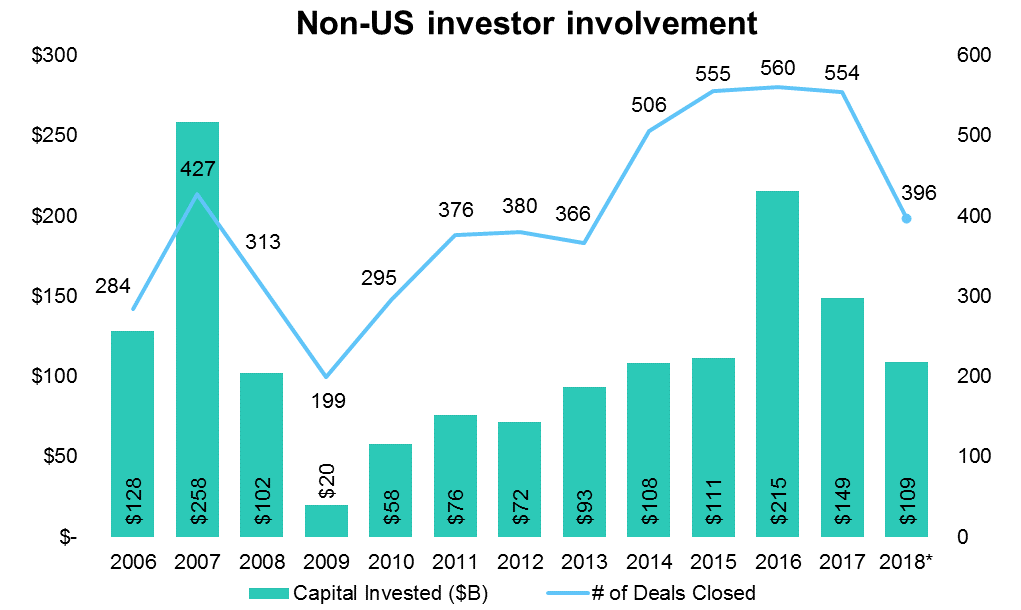
Foreign PE investment in US-based companies has been strong going back to 2014. And consistent. Since 2014, non-US investors were involved in about 12% of all US-based PE investments per year. The US private equity market is easily the most developed market available, and while the European and Asian markets steadily play catchup, it’s not surprising to see a consistent amount of foreign investment over the years. Many of these transactions involve Canadian firms, which have a much smaller supply of targets to work with compared to their neighbors. To be sure, the accompanying numbers only reflect non-US involvement in deal activity; in many cases, that amounts to a minority financing from a foreign investor to support a US-based lead investor. The consistency, however, suggests a strong network effect has been in place between US and non-US investors going back several years.
With that in mind, we’ve seen would-be acquisitions blocked due to national security concerns recently, and the current political climate won’t do much to assuage those fears. Recall last year’s attempt by Canyon Bridge Capital Partners to acquire Lattice Semiconductors, an Oregon-based chipmaker. The deal was a planned $1.3 billion take-private, but some of Canyon Bridge’s limited partners were tied to Chinese government funds and to its space program. The deal was nixed by the US government because Lattice’s underlying technologies had potential military uses, a justification used by earlier administrations, as well. But with so much talk of trade wars and tariffs at the moment, foreign investment in general is in the spotlight. The Committee on Foreign Investments in the United States (CFIUS) conducts national security reviews of any deals that could result in control of US companies by foreign investors. “Control,” according to several legal reviews, could also include minority investments, and impacted sectors aren’t limited to aerospace and defense—they can include investments in energy, healthcare, telecom and cybersecurity, all major playing fields for private equity. Going forward, it’s easy to imagine foreign investors shying away from deals—even ones they aren’t leading—if they are going to draw unwanted attention from regulators. A lot of time and energy is spent getting to the definitive agreement stage, and PE firms are allergic to risks that are out of their control. CFIUS, for what it’s worth, assumes Canadian investors pose less of a national security threat, so a floor should remain going forward.
Contact: Alex Lykken
alex.lykken@pitchbook.com



Latest news

US Leveraged Loans Return 3.36% to Investors YTD
The Bloomberg US Leveraged Loan Index (Ticker: LOAN) returned 0.96% in August and has gained an additional 0.28% through September…

PE dry powder
The capital that is being raised is flowing overwhelmingly to the largest, most established managers.

Middle market debt held by BDCs vs High yield vs Treasury yields
The blue line represents the current dividend yield of the VanEck BDC Income ETF (BIZD), which stood at 11.7% as…