


Preqin Private Debt Intelligence – 5/30/2016

Distressed Debt Fundraising Overtaken by Direct Lending in North America
During the Global Financial Crisis (GFC), the distressed debt market in North America established itself as the driving force behind the emerging industry of private debt in the region. Throughout 2007 and 2008, an aggregate $80bn was raised through distressed debt vehicles as investors allocated swathes of capital to capitalise on the sheer quantity of opportunities in the wake of economic collapse.
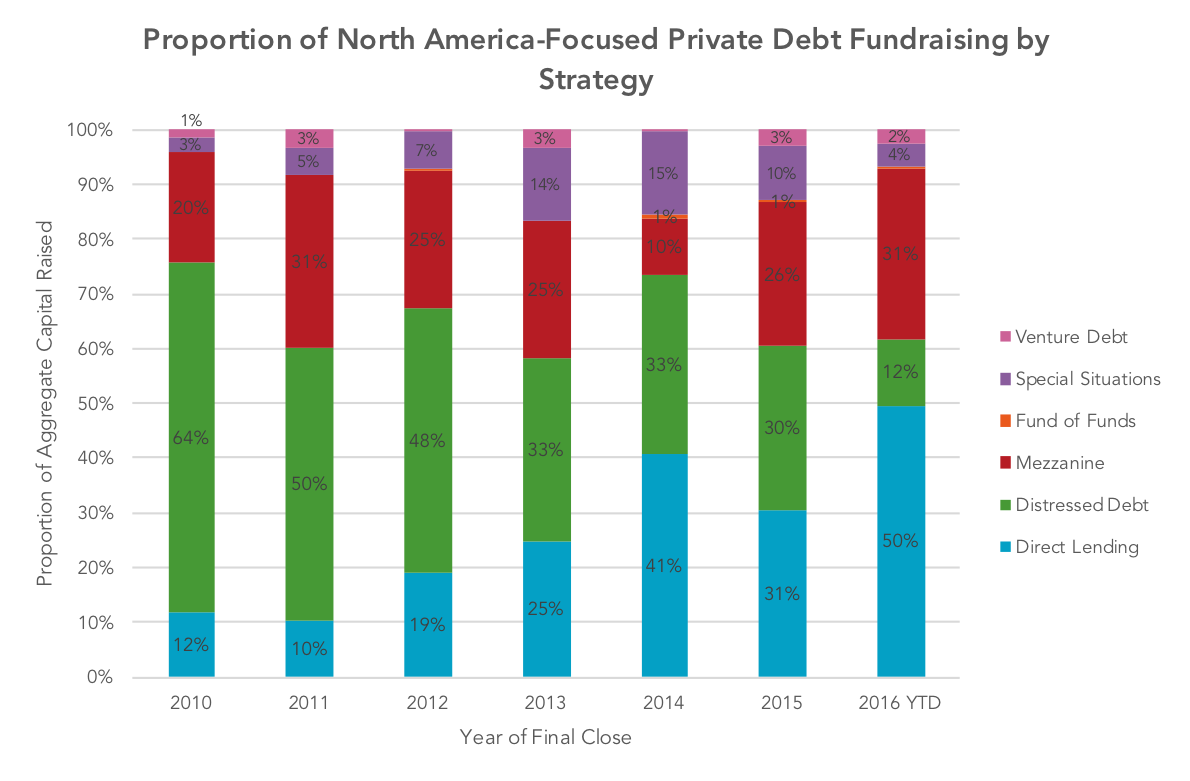
Following the calming of global market turbulence – 2009 onwards – distressed debt fundraisings have not threatened to reach the peaks of the GFC. In fact, the combined $21.6bn raised back in 2010 is the highest total since the GFC indicating that the growth of the private debt asset class has not been reflected in the distressed debt industry specifically. This trend has also been reflected in the global distressed debt fundraising market as North America-focused funds continue to attract the vast majority of investor capital due to the established credit landscape in the region.
Given the calming in North America-focused distressed debt fundraising, direct lending funds have seen greatly increased levels of capital flowing into the debt type. In 2010, distressed debt vehicles targeting investments in North America, raised 64% of all investor commitments in the private debt industry however this proportion more than halved to 30% through 2015 and currently stands at 12% in 2016 YTD.
In contrast, direct lending funds secured just over a tenth (12%) of the total capital raised in 2010, however the debt type attracted a greater proportion (41%) of annual private debt North America-focused investor capital than distressed debt types (33%) in 2014. In 2016 YTD, despite the sluggish industry-wide fundraising landscape, North America-focused direct lending funds have secured 50% of all investor commitments.
However, several large distressed debt funds are nearing final closes – the most notable being the Oaktree Opportunities Fund Xb, which is now on its third close targeting $7bn – and so the latter half of 2016 could see the distressed debt landscape in North America enlivened.
Contact: Sam Livingstone
sam.livingstone@preqin.com





Latest news


Software, consumer-related direct lending deals fell in H1'26
The software and technology sector, the second-most-active sector in 2025 at 17% of total deal activity, slid to fifth place in the first half of 2026.

Unconquered Territory
With most of the map still unexplored, there’s room for a sequel.