



Private credit is still having much success raising capital from institutions, but it doesn’t stop the retail investor from taking the spotlight.
On the face of it, private credit fundraising from institutions is going strong. Our latest data shows such fundraising hit a record high for the first nine months of the year with $252.7 billion raised, just above the $251.6 billion raised in the same period in 2021.
If the momentum is maintained, then 2025 might set a new record for the asset class, driven partly by more challenging conditions in other parts of the private markets, such as private equity.
It may seem a strange time, therefore, to question whether the future of private credit fundraising rests not with institutions but with retail investors. Nonetheless, the rise of the retail investor is – and will continue to be – a huge talking point.
“I think it’s going to be very hard for managers to resist the allure of retail capital if the opportunity is there,” Jeffrey Griffiths, global head of private credit at placement agent Campbell Lutyens told PDI.
“Particularly the publicly listed managers are going to find it virtually impossible to not do it because their shareholders will demand it – the way they’re business is valued and run will necessitate finding new sources of AUM so I think it will be very hard for any manager that has a credible retail opportunity not to go after it.”
The Hamilton Lane Market Overview 2025 said “our view is that evergreen structures will come to form a major part of the private markets landscape in a very short time frame” and expressed 100 percent confidence that such vehicles would grow faster than the overall rate of public markets over the next five years. The same survey was also 100 percent confident that closed-ended funds in certain strategies would decline and largely disappear.
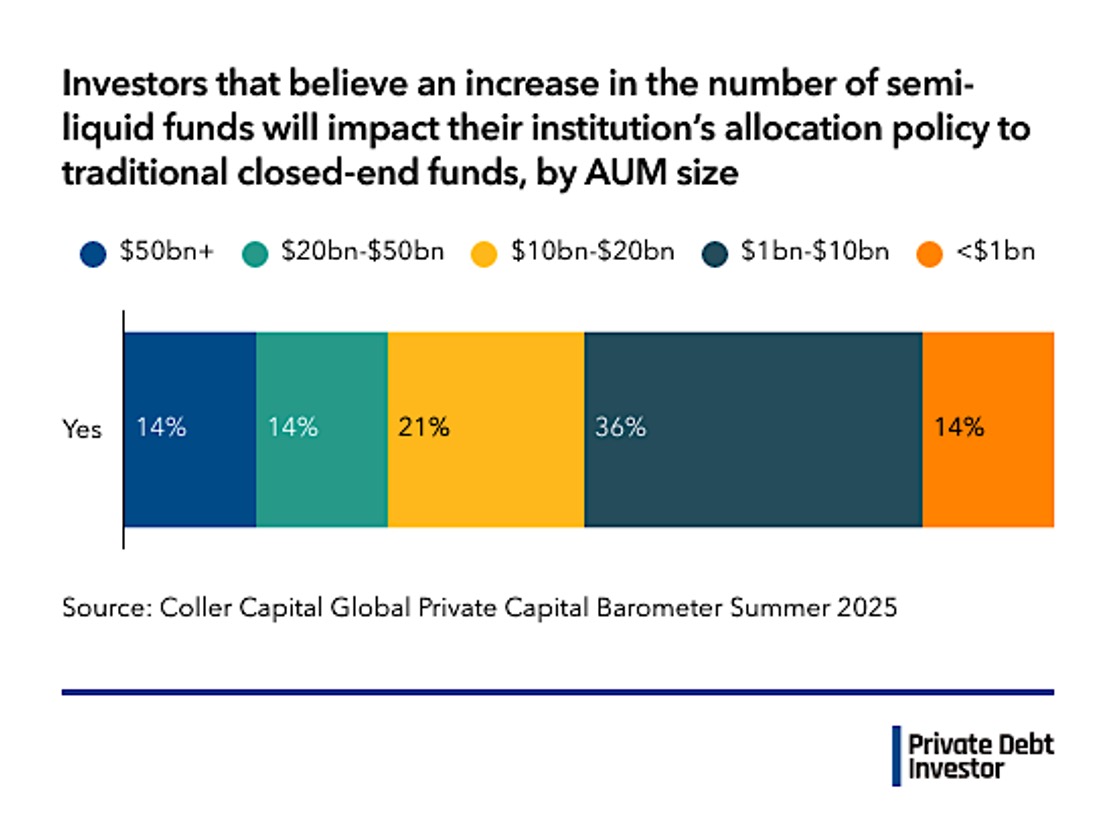
Research from fund manager Coller Capital (see chart) is supportive of the theory that the growth of retail capital might have an impact on institutional fundraising. This is particularly the case for larger investors, with 36 percent of those sized between $1 billion and $10 billion saying an increase in semi-liquid will impact their allocation policy towards traditional closed-ended funds.
The era of widespread retail investment in private markets is upon us.



Latest news

US Leveraged Loans Return 3.36% to Investors YTD
The Bloomberg US Leveraged Loan Index (Ticker: LOAN) returned 0.96% in August and has gained an additional 0.28% through September…

PE dry powder
The capital that is being raised is flowing overwhelmingly to the largest, most established managers.

Middle market debt held by BDCs vs High yield vs Treasury yields
The blue line represents the current dividend yield of the VanEck BDC Income ETF (BIZD), which stood at 11.7% as…