


Markit Recap – 10/30/2017

Venezuela – are we close to default?
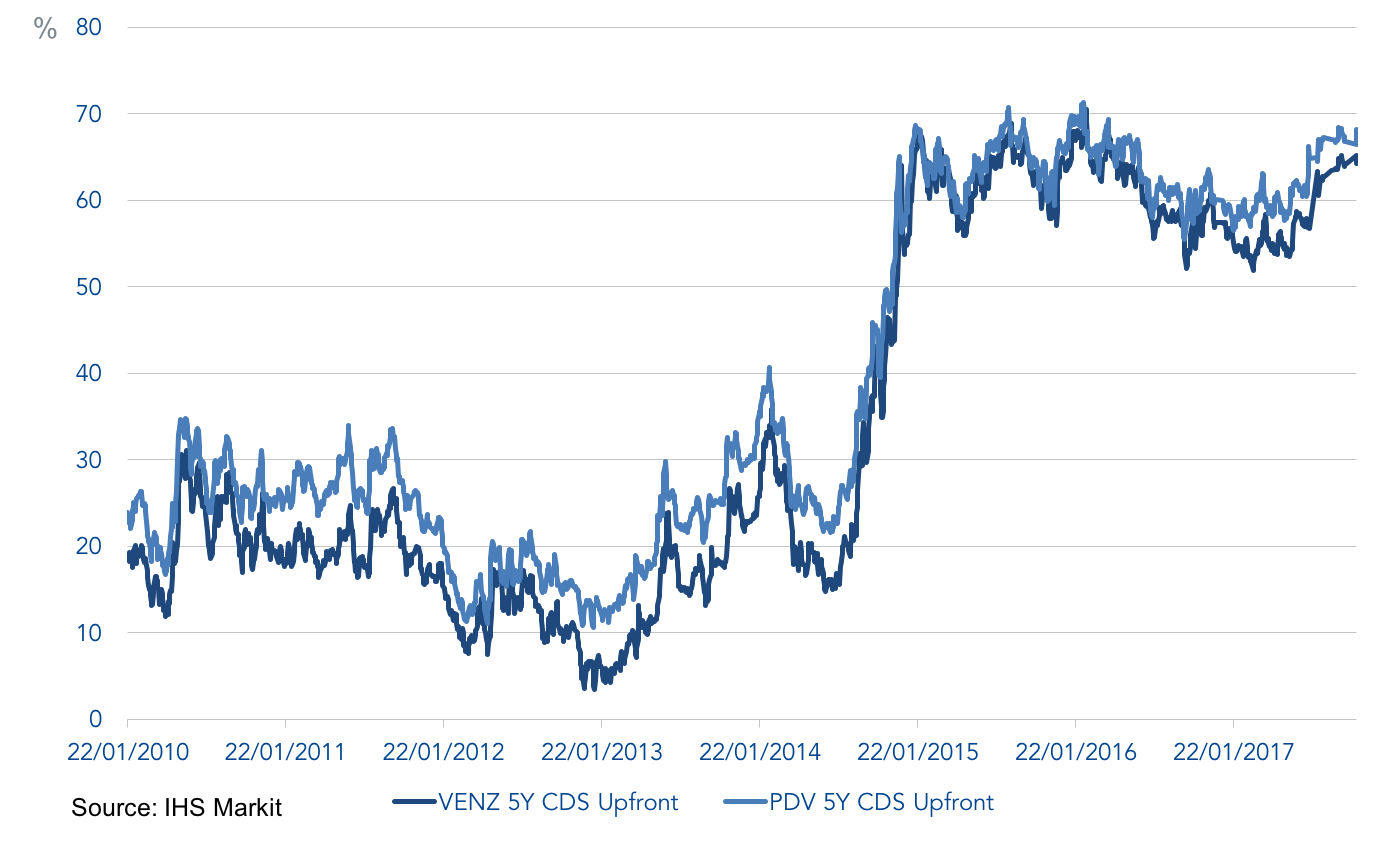
Waiting for a default on Venezuela’s bonds has been like waiting for Godot. Low oil prices and macroeconomic mismanagement has led to a catastrophic collapse in economic activity – our colleagues in country risk are forecasting a 7.5% GDP contraction. Civil unrest is on the rise, inflation is soaring and the situation is worsening by the day. Surely the current direction is unsustainable?
The CDS market certainly suggests the end is near. The 5-year level is at 64.5 points upfront, and there is now an active market in the short-end of the curve. It is a similar story with the PDVSA CDS, with the state-owned oil company 5-year trading at 68 points.
But it’s worth noting that CDS levels have been trading over 50 points for almost three years and no default materialised. Is this time different?
Perhaps. It appears that Venezuela actually missed interest payments on some bonds last month, and when the 30-day grace period expires a credit event question may well be asked of the ISDA Determinations Committee. If answered I the affirmative, that would bring the long-running saga to a conclusion.
But the Venezuelan government’s commitment to servicing external debt instead of importing essential consumer goods has proved steadfast so far, and it is not clear that the missed interest payments mark a shift in policy. It could well be the case that the payments were missed in order to help pay the principal amounts on PDVSA, which don’t have grace periods. It appears that the principal due on October 27 was paid (though at the time of writing this was uncertain) and the bond market is implying that the PDVSA principal due on November 2 will also be met.
It’s worth noting here the relationship between the sovereign and PDVSA. There is a very close correlation between the CDS levels of the two names, indicating that they are more or less the same credit. But from a legal perspective this is not the case. There are no guarantees or cross default provisions (between the two entities – there are intra-entity cross default clauses) in bonds issued by the two entities, so they are legally two distinct credits.
Rather, the relationship is both economic and political. Oil generates over 95% of Venezuela’s exports and the linkages between PDVSA and the sovereign run deep. PDVSA effectively services the debt of the sovereign, though it is important to note that the latter owns the oil in the ground while PDVSA owns the oil from point of extraction to sale. Crucially, however, PDVSA also owns most of the fixed assets in foreign jurisdictions, such as refineries and tankers. The CITGO refinery in the US is particularly important as collateral and could play a key role if there were holdouts in any potential restructuring. The sovereign’s bonds, unlike PDVSA’s, include collective action clauses, which would make it more difficult for holdouts to gain leverage.
So, it is theoretically possible for a restructuring of debt to occur at one of the entities but not the other. The existence of CACs on the sovereign bonds mean that a restructuring would likely trigger CDS (as the restructuring would be binding). It would likely be more complicated for a selective default on PDVSA bonds.
However, the very close economic and political links between the two entities mean that their credit fortunes are intertwined, but not necessarily the same. A scenario where a failure to pay credit event occurs on one entity and a restructuring on the other, for example, is possible. Or PDVSA could somehow fund the funds to meet the interest payments before the grace periods expire, and the speculation will die down until the next major payments are due next year. Maybe we will just have to keep waiting.
Contact: Gavan Nolan
Gavan.Nolan@ihsmarkit.com





Latest news

Rate hike expectations ease as term SOFR curve flattens
The CME six-month Term SOFR rate reached a recent high of 3.979% on July 28 before retreating to 3.837% as…
3Q26: New loan assets rise to 44% of total lending, a 3-year high
New loan assets as a proportion of total US loan volume make up 44% of the 3Q26 pipeline to date,…

North American GPs dominant as fundraising accelerates
Our PEI Private Credit 200 ranking also shows capital raising increasing overall – and accelerating especially fast for the largest…